Buckling pin relief valves, and when a pin beats a spring
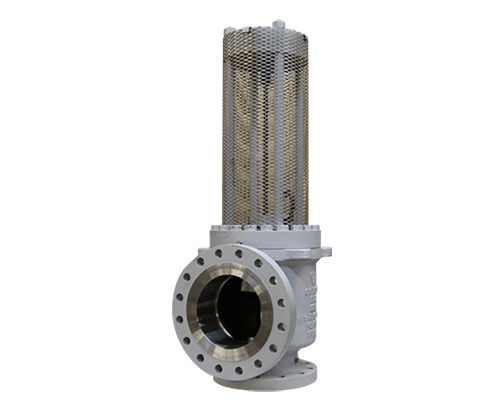
A spring-loaded relief valve simmers as it approaches set pressure. A buckling pin valve holds shut to 95% of set and then opens fully. That difference is why the BS&B range exists.
A conventional spring-loaded relief valve is a compromise that everyone has agreed to live with. The spring is doing two jobs at once: holding the disc closed, and deciding when to let go. As process pressure climbs toward set, the net force holding the seat shut falls away, and the valve starts to weep before it lifts. That is why operators are told to run well below set pressure, and why simmer and seat damage are ordinary maintenance items rather than faults.
A buckling pin valve separates the two jobs. A slender pin held in compression carries the load, and the pin's buckling point, not a spring rate, sets the release pressure. Below that load the pin is rigid and the seat is fully loaded. Above it, the pin buckles, and it does so decisively.
What that buys
- An operating-to-set pressure ratio of 95% minimum across the BS&B range, so the plant can be run much closer to set pressure without simmer.
- Full opening at the set point rather than a progressive lift.
- Back pressure independence, so the valve suits variable or constant back pressures without a bellows.
- External reset in minutes, without opening the pipeline. On hazardous service that is the whole argument: the reset does not expose an operator to the process.
The trade is that a buckling pin valve is a single-action device. Once the pin buckles, it is replaced. That suits duties where a relief event is an incident to be investigated rather than a routine occurrence, and it suits duties where nobody wants to break containment to service a valve.
The range, and what separates the models
| Model | Set pressure | Media | Notable for |
|---|---|---|---|
| BPAV™ | 15 to 3,500 psi | Liquid and gas/air | Kd 0.8 gas, 0.686 liquid |
| BPCV™ | 15 to 3,500 psi | Gas / liquid | Built for pump bypass duty |
| BPIV™ | 1 to 2,250 psi | Large diameter | 2 NPS to 60 NPS |
| EORV™ | 5,000 to 20,000 psig (344 to 1,378 barg) | Liquid | 1/4 in orifice, ASME VIII Div. 1 / PED |
Set pressure ranges vary by size and orifice. See each product page for the full size and set-pressure tables.
The spread here is unusually wide for one technology. EORV™ works at 5,000 to 20,000 psig on a quarter-inch orifice, while BPIV™ runs from 2 NPS to 60 NPS with flow areas from 2.75 sq in up to 2,206 sq in. They are the same idea at opposite ends of the scale.
On the large-bore valves the set pressure available depends on the size, and it steps down as the bore grows: 15 to 2,250 psi at 2 to 4 NPS, 1 to 2,250 psi from 6 to 14 NPS, 1 to 1,440 psi from 16 to 20 NPS, and 1 to 720 psi from 24 NPS upward. That is worth checking early, because it is the constraint most likely to move a selection.
Pump bypass, specifically
BPCV™ is listed for pump bypass duty, which is a duty that punishes spring valves. A positive displacement pump against a closed discharge builds pressure fast, and a valve that simmers first will pass fluid it should not while the pressure is still rising. A device that holds to 95% of set and then opens fully is doing the job the bypass was specified for.
How to ask
Set pressure, line size, and whether the service is liquid or gas will get you a model and a flow area. Add the back pressure conditions and whether the location is hazardous, and the reset argument either applies to you or it does not. The full range sits under Safety Device.
Specify a buckling pin valve
Send us the set pressure, the line size and whether the service is liquid or gas. We will confirm the model, the flow area and the pin.