Protecting an atmospheric tank: breather valves, vents and arresters
A storage tank is a thin-walled pressure vessel with almost no pressure rating. What keeps it intact is a set of devices sized to API 2000, and knowing which one does which job.
An atmospheric storage tank tolerates remarkably little pressure difference in either direction. Fill it too fast and the vapour space has nowhere to go. Empty it too fast, or let it cool after a hot fill, and the vapour space contracts and the tank tries to collapse inward. Both failure modes are ordinary operations carried out slightly too quickly.
The devices that prevent this are sized to API 2000, and the settings are quoted in millimetres of water column because the pressures involved are that small. The TOPSAFE range in the HKM catalogue covers the whole set, and the useful thing is to know which device answers which failure mode.
Normal venting: the breather valve
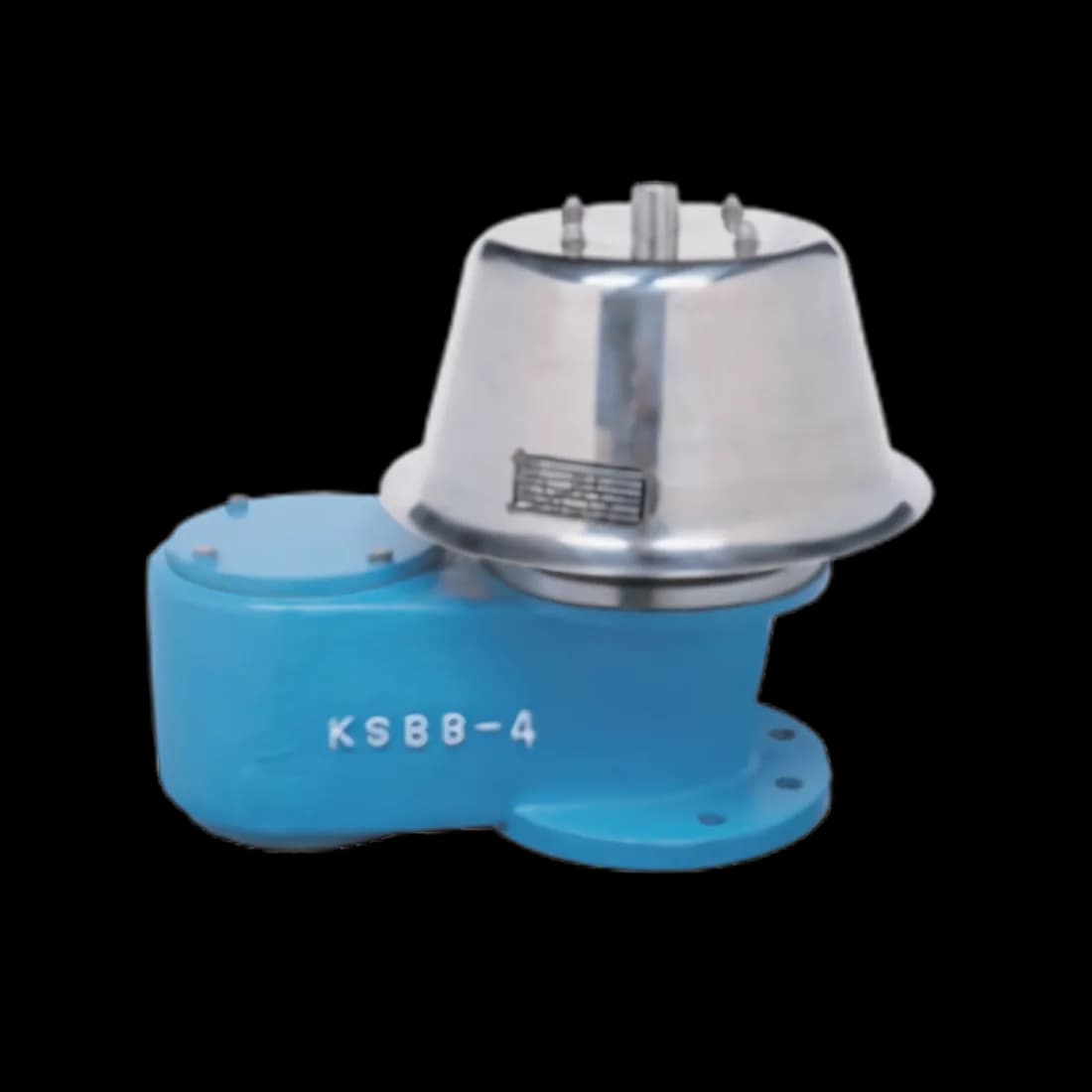
A pressure vacuum relief valve, or breather valve, handles the everyday case: it lets vapour out as the tank fills or warms, and lets air in as it empties or cools, while keeping the tank closed the rest of the time so product is not lost to evaporation.
| Device | Function | Setting range | Size range |
|---|---|---|---|
| KSBB/BS | Pressure and vacuum, vent to atmosphere | ±20 to ±700 mmW.C weight loaded; ±700 to ±7,000 mmW.C spring loaded | 50 mm to 300 mm |
| KSBG/GS | Pressure and vacuum, pipe away | As above | 50 mm to 300 mm |
| KSVR/VS | Vacuum relief only | −20 to −700 mmW.C weight loaded; −700 to −7,000 mmW.C spring loaded | 50 mm to 300 mm |
| KSBBFI/BSF | Breather valve with integral flame arrester | ±20 to ±700 mmW.C weight loaded; ±700 to ±7,000 mmW.C spring loaded | 50 mm to 300 mm |
Settings as printed on the TOPSAFE datasheets. All are designed to API 2000; KSBBFI/BSF also to BS 7244.
Two details in that table decide most selections. The first is weight loaded against spring loaded: below 700 mmW.C the setting is made with weights, above it with a spring, and the crossover is the same in both directions. The second is vent to atmosphere against pipe away. KSBB/BS discharges locally and is FM approved for the majority of sizes and materials; KSBG/GS is the version for routing the discharge somewhere else.
Emergency venting: the vent cover
A breather valve is sized for normal in-breathing and out-breathing. It is not sized for a fire under the tank, which generates vapour far faster than any normally sized vent can pass. That case is covered by an emergency vent cover, a large low-set device that lifts only in that scenario. The catalogue carries weight-loaded and spring-loaded covers for high pressure settings, and free vent covers for tanks holding non-volatile liquids where no breather valve is needed at all.
Flame arresters: stopping the flame, not the flow
A flame arrester lets vapour pass while stopping a flame front from travelling with it, by taking heat out of the flame faster than it can sustain itself. The element that does this is a crimped metal ribbon, 316L stainless in this range, with passages narrow enough to quench the specific gas group.
Which arrester you need depends on what the flame is doing when it arrives:
- Deflagration, a subsonic flame front: an in-line arrester such as KSFI, explosion and deflagration proof, 15 mm to 600 mm, designed to API 2000 and EN 12874 and meeting USCG and IMO MSC/Circ.677 requirements.
- Detonation, a supersonic front carrying a shock pressure: UFD, which is built to absorb the shock as well as quench the flame, and is designed for an endurance burn against the flame cell.
- A run of manifolded piping, where a deflagration has room to accelerate: a deflagration arrester intended for long runs.
The standard flame cell across the range suits NEC group D or IEC IIA gases. Cells for other gas groups are available, and this is the specification most often left off an enquiry. If your vapour is not in group D or IIA, say so first, because it changes the cell rather than the size.
Putting a package together
A typical atmospheric tank ends up with a breather valve for normal venting, an emergency vent cover for the fire case, and an arrester wherever a flame could reach the vapour space. Whether the arrester is a separate in-line unit or integral to the breather is a layout decision as much as a process one, which is what KSBBFI/BSF exists to simplify: one body, one flange, both functions.
Size a tank protection package
Send us the tank size, the stored product and your required settings in mmW.C. We will put together the breather, vent and arrester combination to suit.