Choosing a steam trap by how far the condensate is sub-cooled
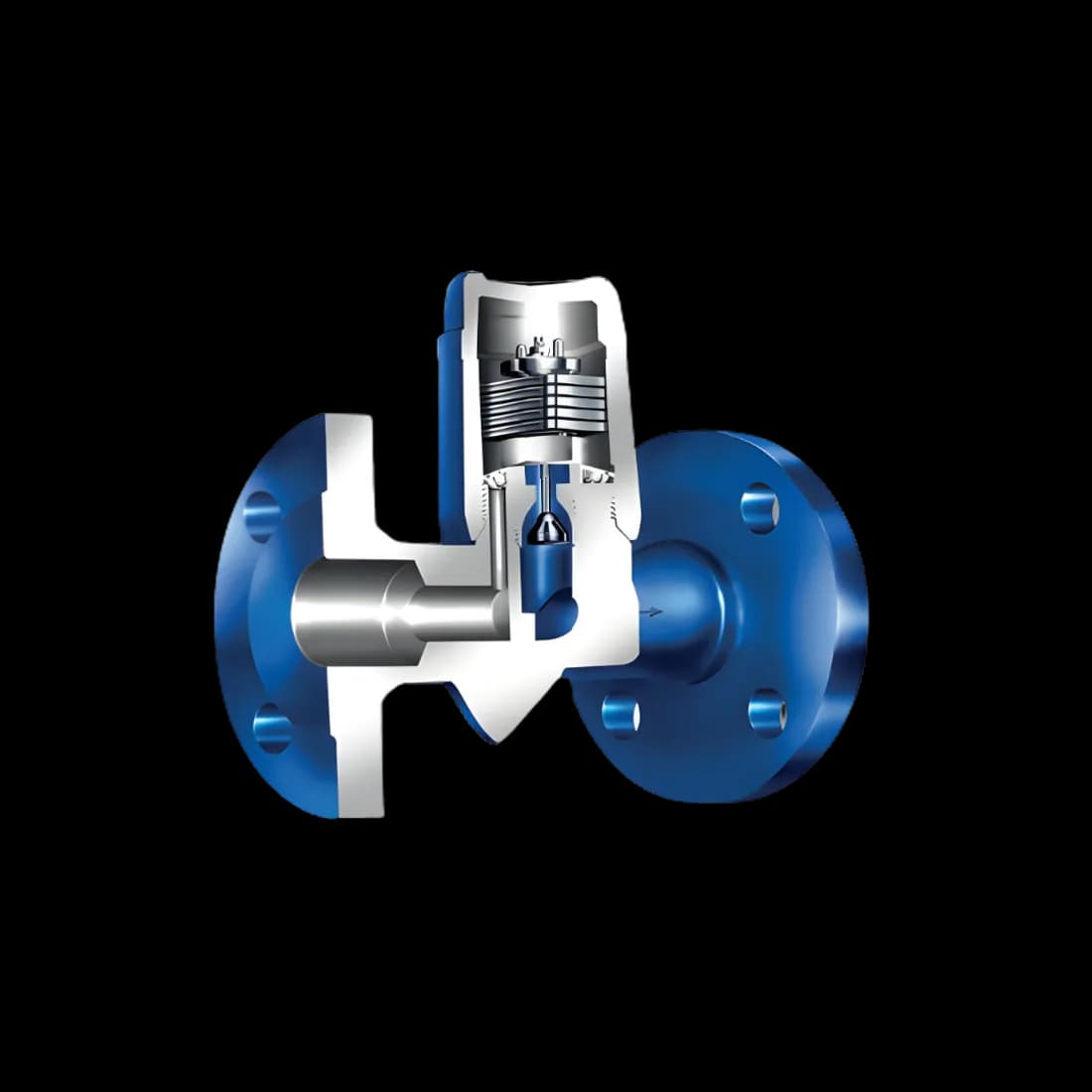
Trap selection goes wrong when it starts from the connection size. Start from how much the condensate has cooled below saturation, and the ARI CONA range sorts itself into four clear answers.
Most steam trap enquiries arrive as a size and a pressure rating. Both are real constraints, but neither answers the question that decides which trap works: how far has the condensate cooled below saturation temperature by the time it reaches the trap?
That number, the sub-cooling in kelvin, is what separates a trap that discharges cleanly from one that either waterlogs the line or blows live steam through to the return. The ARI-Armaturen CONA range in the HKM catalogue is organised almost exactly along this axis, which makes it a useful range to think with.
Why sub-cooling decides the trap
A trap has to tell condensate from steam. The different working principles do that by sensing different things, and each one needs a particular condition to sense reliably.
- A float trap senses level. It does not care about temperature, so it will pass condensate that is still at boiling temperature, continuously, as it arrives.
- A thermostatic trap senses temperature difference. It needs the condensate to have cooled measurably below saturation before it will open, so it holds condensate back to cool it.
- A thermodynamic trap senses flow across a disc. It suits condensate arriving at or near boiling temperature.
Put a trap that needs 30 K of sub-cooling on a line whose condensate arrives at boiling temperature, and it will never see the condition it is waiting for. Put a trap designed to discharge at boiling temperature on a heavily sub-cooled line, and you gain nothing from the cooling you have already paid for.
The CONA range, sorted by sub-cooling
| Trap | Condensate condition | Nominal pressure | Nominal diameter |
|---|---|---|---|
| CONA® B | Sub-cooled between 10 and 30 K | PN 16 to PN 630 | DN 15 to DN 50 |
| CONA® M | Sub-cooled up to 40 K | PN 16, PN 40 | Rp 3/8 to DN 50 |
| CONA® SC | At boiling temperature | PN 16 to PN 160 | DN 15 to DN 100 |
| CONA® All-in-one | Limited sub-cooling | PN 40 | DN 15 to DN 25 |
Applications and ranges as printed on the ARI-Armaturen datasheets.
Read down the first two columns and the selection logic is almost mechanical. CONA® SC is the trap for condensate arriving at boiling temperature, and it is also the one that reaches furthest up in size, to DN 100. CONA® B covers the moderately sub-cooled band and carries by far the widest pressure range in the group, up to PN 630. CONA® M goes further into sub-cooling, up to 40 K, at more ordinary pressures. CONA® All-in-one is the compact answer for small connections with limited sub-cooling.
The two products that are not traps
Two items sit in the same family and are worth knowing about, because they solve problems that get misdiagnosed as trap failures.
- CONA® P is a ventilation valve, not a trap. It prevents the system pressure falling below atmospheric in condensing steam or liquid systems, DN 25 to DN 50. A line pulling a vacuum as it cools will hold condensate back regardless of which trap you fitted.
- ARI-CONLIFT is a condensate lifter, flanged, DN 25/25 to DN 80/50. Where condensate has to rise to reach the return, no trap will lift it for you.
What to have ready before you ask
Three numbers get an answer on the first reply: the operating pressure, the connection type and size, and the condensate condition at the trap. The last one is the one people have to go and find out, and it is the one that determines whether the trap works.
Materials are worth flagging early too. The CONA traps are offered across a wide spread of body materials, from EN-JL1040 cast iron through carbon and low-alloy steels to 1.4541 stainless, and the right one follows from the service rather than from the trap type. The full material list for each trap is on its product page.
Match a trap to your condensate
Tell us the operating pressure, the connection and how far your condensate sits below saturation. We will name the trap and the material combination that fits.