Composite hoses for LPG and LNG transfer
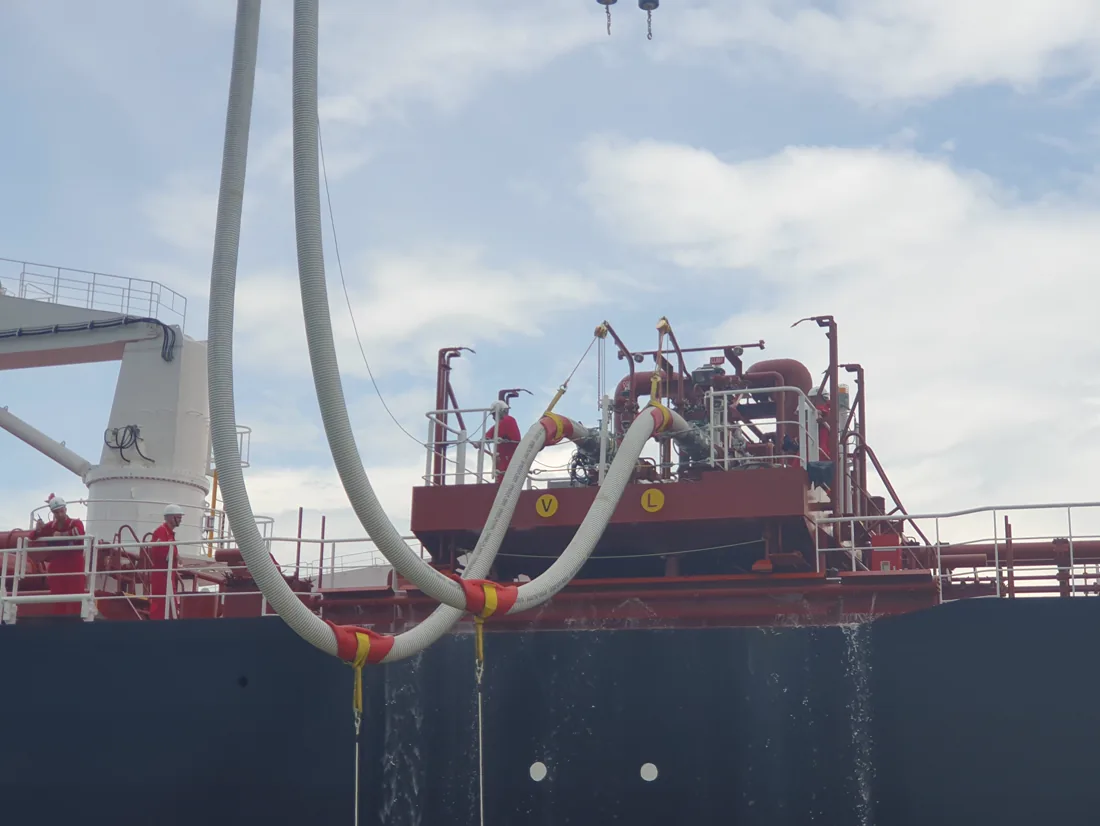
A composite hose is not a rubber hose with a different lining. It is an unbonded assembly of films and fabrics between two wire helices, and that construction is what makes cryogenic transfer possible.
Composite hose is built differently from every other flexible hose on a terminal. There is no vulcanised rubber and no bonded carcass. Instead, layers of thermoplastic film and fabric are wrapped, unbonded, between an inner and an outer wire helix, and the whole assembly is held together by the wires rather than by adhesion between layers.
That sounds like a weakness and is actually the point. Unbonded layers move relative to each other, so the hose flexes tightly without the layers tearing away from one another, and a single puncture does not propagate through the wall. It is also why composite hose handles cryogenic service, where a bonded construction would fail at the bond line as the materials contract at different rates.
What is common across the range
Every Dolphinflex hose in the catalogue shares the same structural characteristics, which are quoted identically on each datasheet:
- Minimum burst pressure of 5x working pressure, a 5:1 safety factor.
- Maximum elongation of 10% on proof pressure.
- Electrical resistance of 2.5 Ohm/m or less below 50 mm bore, and 1.0 Ohm/m or less above 50 mm. On a hydrocarbon transfer hose this is a safety property, not an electrical one: it is what lets static generated by flowing product find its way to earth rather than to a spark.
Bore sizes run from 1 in (25 mm) to 12 in (300 mm) across the range, with the bend radius, weight and maximum length tabulated per size on each product page.
Selection starts with temperature
| Hose | Temperature range | Lining and cover | Standard |
|---|---|---|---|
| Black | −30 °C to +80 °C | Polypropylene fabrics, PVC coated polyester cover | EN 13765:2010 |
| LPG | −50 °C to +50 °C (−105 °C to +50 °C for liquid ethylene) | Polyamide fabrics, polyamide cover | EN 13766:2010 |
| LNG | −196 °C to +50 °C | Polyamide fabrics, polyamide cover | EN 13766:2010 |
As printed on the Dolphinflex datasheets. All three carry stainless steel 316 inner wire.
The standard is the fastest way to read that table. EN 13765 covers hoses for hydrocarbons, solvents and chemicals; EN 13766 covers hoses for liquefied petroleum gas and liquefied natural gas. A hose certified to one is not a substitute for the other.
The cryogenic case
Dolphinflex® LNG is rated from −196 °C, which is the boiling point of liquid nitrogen at atmospheric pressure and the practical floor for this kind of service. It is listed for ship to shore, LNG bunkering, storage tank and in-plant loading and unloading. A ship-to-ship variant is available for transfers between vessels.
Dolphinflex® LPG covers a long list of liquefied gases including ammonia, propane, butane, butadiene, propylene and methyl bromide, and carries a separate lower rating of −105 °C specifically for liquid ethylene. Where a terminal handles more than one of these, it is worth confirming the list rather than assuming, because the chemical compatibility is per product rather than per family.
The colour-coded chemical hoses
For general chemical and hydrocarbon duty the range is colour coded rather than numbered, which makes hose identification on a busy jetty a visual check instead of a paperwork one. Black is the general chemicals, oils, solvents and diesel hose, rated −30 °C to +80 °C, with blue, green, red and yellow variants covering other duties, and a dedicated drain hose. The full set is on the Composite Hose page.
What to send with an enquiry
Product, temperature, bore and length answer most of it. The two things most often missed are the end fittings, which have to match the manifold you are connecting to, and the test and certification requirements, which on transfer hose are usually periodic rather than one-off. Both are easier to sort before the hose is built than after.
Specify a transfer hose
Send us the product, the temperature, the bore and the length. We will confirm the hose, the end fittings and the test certification.